
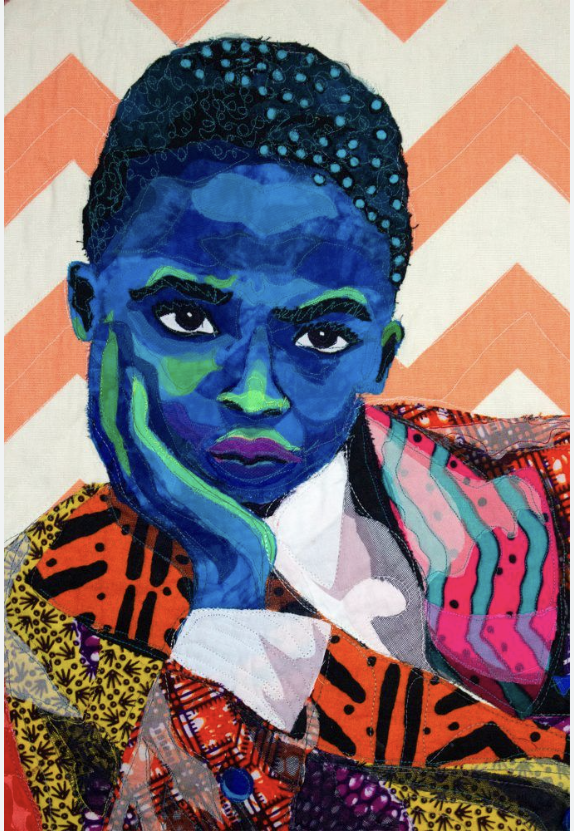


Artist Website


Copenhagen Street life (2019)
101 x 101 cms
Applique and layered cotton and polyester foil, orange threads
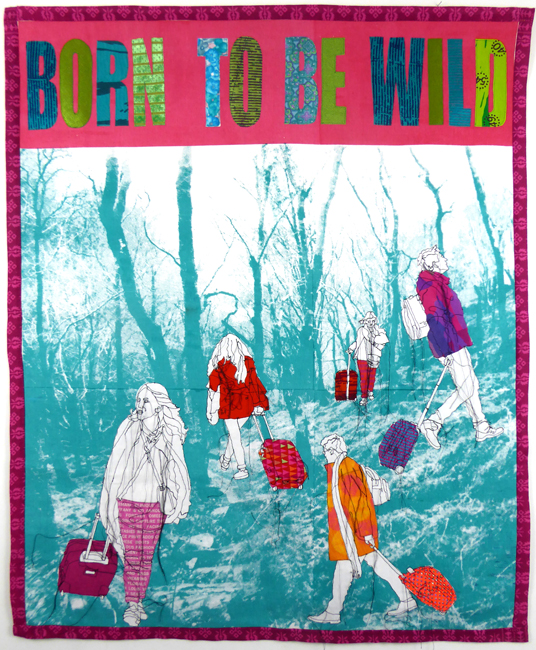
Born to be Wild (2018)
100 x 68 cms
Applique and screen print on cotton canvas
More to see. Go to link below:
https://www.textilecurator.com/home-default/home-2-2/rosie-james/


Appliqué, sewing technique in which fabric patches are layered on a foundation fabric, then stitched in place by hand or machine with the raw edges turned under or covered with decorative stitching. From the French appliquer, “to put on,” appliqué is sometimes used to embellish clothing or household linens. Like patchwork (piecing), it is a method of constructing or embellishing quilts. (See quilting.)
Eighteenth-century American quilts often combined appliquéd motifs with pieced patchwork. Quilters cut printed motifs from expensive imported chintz—usually florals and birds, but sometimes animals—and appliquéd them to plain muslin in a process known as broderie perse (“Persian embroidery”). It remained a favourite technique for “best quilts” until replaced toward the mid-19th century by the elaborate appliqué patterns—wreaths, urns of flowers, sentimental and patriotic designs—of Baltimore Album quilts and other red and green floral appliquéd styles.
Like patchwork, appliqué designs were often inspired by everyday life, especially the flower garden. They also commemorated political and philosophical views. Nineteenth-century appliqué designs were often made in larger scale; as few as four blocks were needed for a full-sized quilt. The 20th century, especially the Depression era of the 1930s, produced its own crop of appliqué designs like Sunbonnet Sue and Dresden Plate, often embellished with embroidery and rendered in the pastels popular during the period. Large-scale Hawaiian appliqués feature abstract motifs inspired by local flowers and plants that are cut out of a single piece of folded cloth. They are usually made of solid colours rather than prints and are outline quilted around the motif in ever-increasing ripples.


Adopting a unique process of assemblage, Konaté cuts-up, dyes, sews, and reassembles pieces of fabric (mostly cotton), then reconfigures them into large-scale, boldly coloured tapestries with incredibly detailed surfaces, creating arresting optical effects.
Working mostly with textile materials, dyes, and dyeing techniques indigenous to his native Mali, Konaté's installations form abstract visual tableaus which are at once explorations in colour and weaving cloth yet speak to more complicated global socio-political themes that resonate far beyond his local context.
In early works on paper rendered in acrylic, colourful motifs refer to graphic signs and cosmological symbols used by Malian societies, the most prominent of these being ciwara (or amulets)—a ritual object representing an antelope head, used by the Bambara ethnic group in Mali. The head of the beast, which typically forms part of a zoomorphic crest with elegant lines, evokes the graceful ripple of an antelopes form and is an important symbol used in masks worn to perform traditional dance and rituals of initiation.
Colour in Konaté's work isn't merely aesthetic and serves as a metaphor for themes as diverse as war, power struggles, religion, globalisation, ecological shifts, and the AIDS epidemic which he poignantly visualised in his 1995 work Lutte contre de HIV. This large textile work depicts a figure with an imposing red target at its centre, suggestive of being marked by illness, accompanied by a suitcase placed in front, containing three screenprints and a blanket referencing personal artefacts and ephemera related to the suffering brought on by the disease.
As the artist has previously said of his influences, 'I can say that in my art there are two well-defined lines of thought. On the one hand, there is the purely aesthetic side, influenced by the nature and cultural traditions of Mali, my country, and that determines the colours and the materials of my work. On the other hand, there is a more spiritual side, which stems from the desire to investigate and describe through my work the human suffering, which reflects itself on the relations between states, politics, the environment, society and the family. Addressing very urgent issues such as AIDS, fanatism and environmental threats, my works draw attention to the problems that plague the modern man and that are caused by a fundamental lack of tolerance in Africa as elsewhere in the world.'
Text Source: https://ocula.com/artists/abdoulaye-konate/

Source link:
https://www.unitedstatesartists.org/fellow/bisa-butler/


Bisa Butler was born to educators in Orange, NJ, the youngest of four children. Butler earned a BFA from Howard University, where she refined her natural talents under the tutelage of lecturers such as Elizabeth Catlett, Jeff Donaldson, and Ernie Barnes. She later began to experiment with fabric as a medium and collage technique. During graduate studies at Montclair State University, where she earned her MA in 2005, she took a Fiber Arts class and had an artistic epiphany, finally realizing how to express her art by combining painting and drawing skills with sewing.
Butler worked as a high school art teacher for ten years in Newark Public Schools and for three years at Columbia High School in Maplewood, NJ. Her work has been acquired by the Art Institute of Chicago, the Museum of Fine Arts, Boston, the Nelson-Atkins Museum of Art in Kansas City, MO, the Orlando Museum of Art in Florida, the Minneapolis Institute of Art, and many other public and private collectors. In the fall of 2020, a solo exhibition of her work opened at the Art Institute of Chicago, the second stop of a traveling exhibit that began at the Katonah Museum of Art in Katonah, NY; her work was concurrently featured as part of a group show at the Toledo Museum of Art in Ohio. Butler is represented by Claire Oliver Gallery in New York.

Artist Website:
